
Ciel Variable
Ciel Variable, 2000
par François Dion
Ciel Variable
Musée canadien de la photographie contemporaine, Ottawa du 19 mai au 17 septembre 2000
À première vue, l'exposition semble vouloir présenter une sélection de travaux de jeunes artistes qui se sont distingués, ces dernières années, sur la scène canadienne. Cette entreprise est particulièrement bienvenue, surtout lorsqu'elle est le fait d'une institution muséale majeure. Par contre, les habitués des galeries et des manifestations d'arts visuels ne seront pas surpris de retrouver ici des œuvres exposées maintes fois et reproduites dans diverses publications. Signe que les musées, même ceux qui présentent de jeunes pratiques, se situent trop peu souvent en amont. Il y a toutefois un certain effet de surprise et de plaisir à voir une si grande diversité de propositions.
Le texte de la brochure, écrit par Andrea Kunard (son nom n'apparaît pas comme commissaire), présente avec un certain sérieux les enjeux de l'exposition. Selon l'auteure, notre époque aurait adopté une vision du monde différente de la vision traditionnelle. La tradition est basée, selon elle, sur une conception qui accorde une certaine objectivité au dispositif photographique et sur l'unicité de la perspective adoptée par l'artiste. L'attitude contemporaine serait redevable, elle, au fragment et à la « connaissance provisoire » (principaux concepts utilisés par Kunard). Toutefois, cette explication est quelque peu remise en cause par les artistes eux-mêmes. L'exemple de Janita Eyre, et sa filiation avouée avec la photographe du XIXe siècle Hanna Maynard, remet en question l'énoncé de Kunard sur l'unicité de la perspective traditionnelle. L'attachement au paysage place Schinkle, et plus particulièrement Yves Arcand, dans une filiation directe avec le passé. Greg Staats, qui exposait au même moment au Centre d'art indien, à Hull, parle de sa tentative d'établir « une communication plus complète » et plus inclusive. L'explication de Kunard aurait eu avantage à explorer la façon dont les artistes s'attachent à cet héritage photographique, l'examinent ou le rejettent, et se situent dans le contexte actuel, plutôt que d'annoncer une rupture.
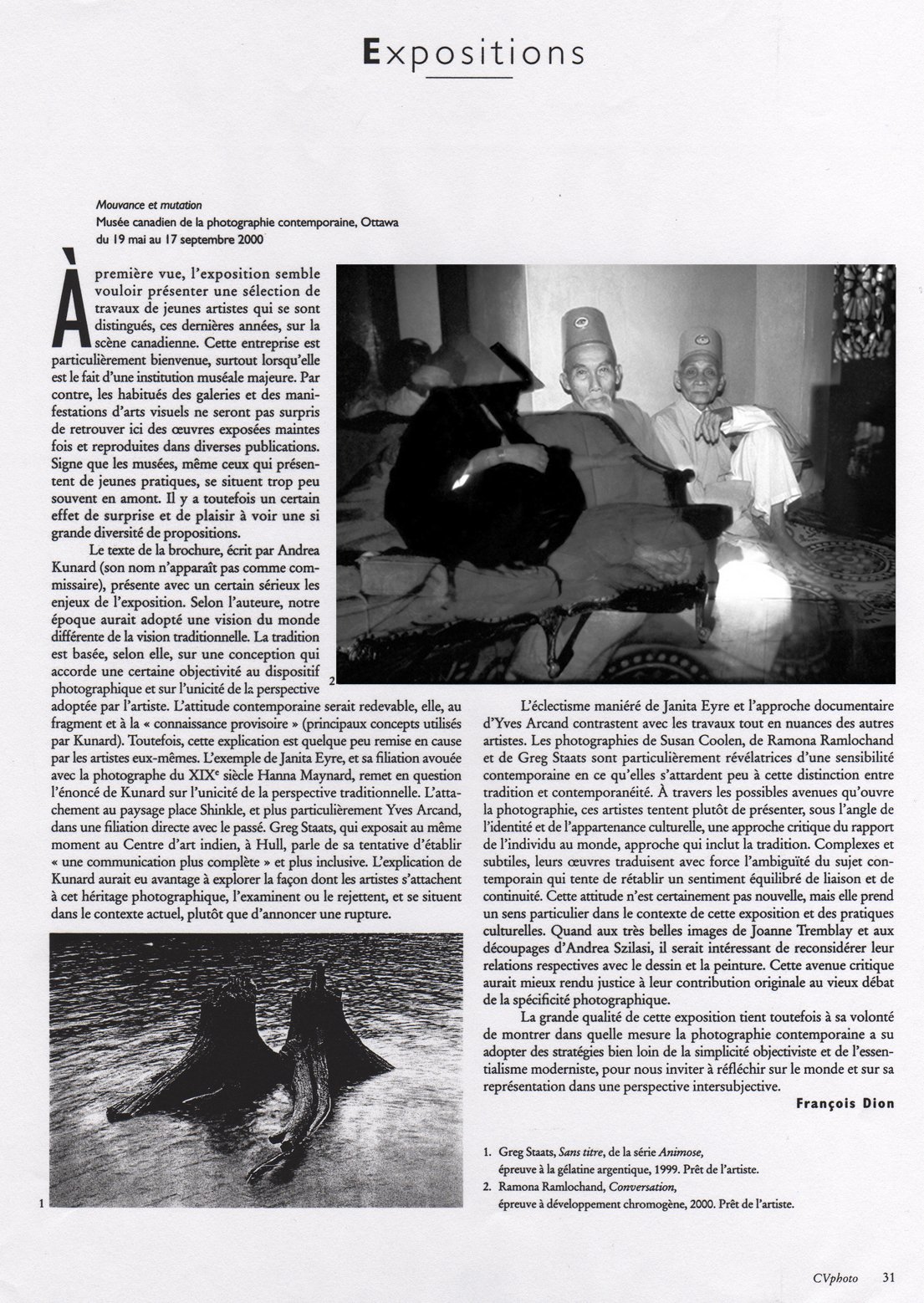
L'éclectisme maniéré de Janita Eyre et l'approche documentaire d'Yves Arcand contrastent avec les travaux tout en nuances des autres artistes. Les photographies de Susan Coolen, de Ramona Ramlochand et de Greg Staats sont particulièrement révélatrices d'une sensibilité contemporaine en ce qu'elles s'attardent peu à cette distinction entre tradition et contemporanéité. À travers les possibles avenues qu'ouvre la photographie, ces artistes tentent plutôt de présenter, sous l'angle de l'identité et de l'appartenance culturelle, une approche critique du rapport de l'individu au monde, approche qui inclut la tradition. Complexes et subtiles, leurs œuvres traduisent avec force l'ambiguïté du sujet contemporain qui tente de rétablir un sentiment équilibré de liaison et de continuité. Cette attitude n'est certainement pas nouvelle, mais elle prend un sens particulier dans le contexte de cette exposition et des pratiques culturelles. Quand aux très belles images de Joanne Tremblay et aux découpages d'Andrea Szilasi, il serait intéressant de reconsidérer leur relations respectives avec le dessin et la peinture. Cette avenue critique aurait mieux rendu justice à leur contribution originale au vieux débat de la spécificité photographique.
La grande qualité de cette exposition tient toutefois à sa volonté de montrer dans quelle mesure la photographie contemporaine a su adopter des stratégies bien loin de la simplicité objectiviste et de l'essentialisme moderniste, pour nous inviter à réfléchir sur le monde et sur sa représentation dans une perspective intersubjective.
_
At first glance, the exhibition appears to showcase a selection of works by young artists who have distinguished themselves on the Canadian scene in recent years. This is a welcome initiative, especially coming from a major museum institution. However, those familiar with galleries and visual arts events will not be surprised to find works here that have been exhibited many times and reproduced in various publications. This suggests that museums, even those that present emerging artists, too often fail to engage with the art world at an early stage. Nevertheless, there is a certain element of surprise and pleasure in seeing such a diverse range of offerings.The brochure text, written by Andrea Kunard (whose name does not appear as curator), presents the exhibition's themes with a certain seriousness. According to the author, our era has adopted a worldview different from the traditional one. Tradition, she argues, is based on a conception that grants a certain objectivity to the photographic apparatus and on the singularity of the perspective adopted by the artist. The contemporary attitude, on the other hand, is indebted to the fragment and to "provisional knowledge" (Kunard's main concepts). However, this explanation is somewhat challenged by the artists themselves. The example of Janita Eyre, and her acknowledged connection to the 19th-century photographer Hanna Maynard, calls into question Kunard's assertion of the singularity of traditional perspective. The attachment to landscape places Schinkle, and more specifically Yves Arcand, in direct lineage with the past. Greg Staats, who was exhibiting at the same time at the Indian Art Centre in Hull, speaks of his attempt to establish "a more complete" and inclusive communication. Kunard's explanation would have benefited from exploring how artists engage with, examine, or reject this photographic heritage and situate themselves within the current context, rather than announcing a break.Janita Eyre's mannered eclecticism and Yves Arcand's documentary approach contrast with the nuanced works of the other artists. The photographs of Susan Coolen, Ramona Ramlochand, and Greg Staats are particularly revealing of a contemporary sensibility in that they pay little attention to the distinction between tradition and contemporaneity. Through the possible avenues opened up by photography, these artists instead attempt to present, from the perspective of identity and cultural belonging, a critical approach to the individual's relationship to the world—an approach that includes tradition. Complex and subtle, their works powerfully convey the ambiguity of the contemporary subject who tries to re-establish a balanced sense of connection and continuity. This attitude is certainly not new, but it takes on a particular significance in the context of this exhibition and cultural practices. As for the beautiful images of Joanne Tremblay and the cut-outs of Andrea Szilasi, it would be interesting to reconsider their respective relationships with drawing and painting. This critical approach would have better done justice to their original contribution to the long-standing debate on the specificity of photography.The great quality of this exhibition, however, lies in its desire to show to what extent contemporary photography has been able to adopt strategies far removed from objectivist simplicity and modernist essentialism, to invite us to reflect on the world and its representation from an intersubjective perspective.